Reading the classification
After analysis, every move in the list carries a colored badge. It’s the fastest summary of the game: a green column tells a solid game, a red spot marks where everything tipped over.
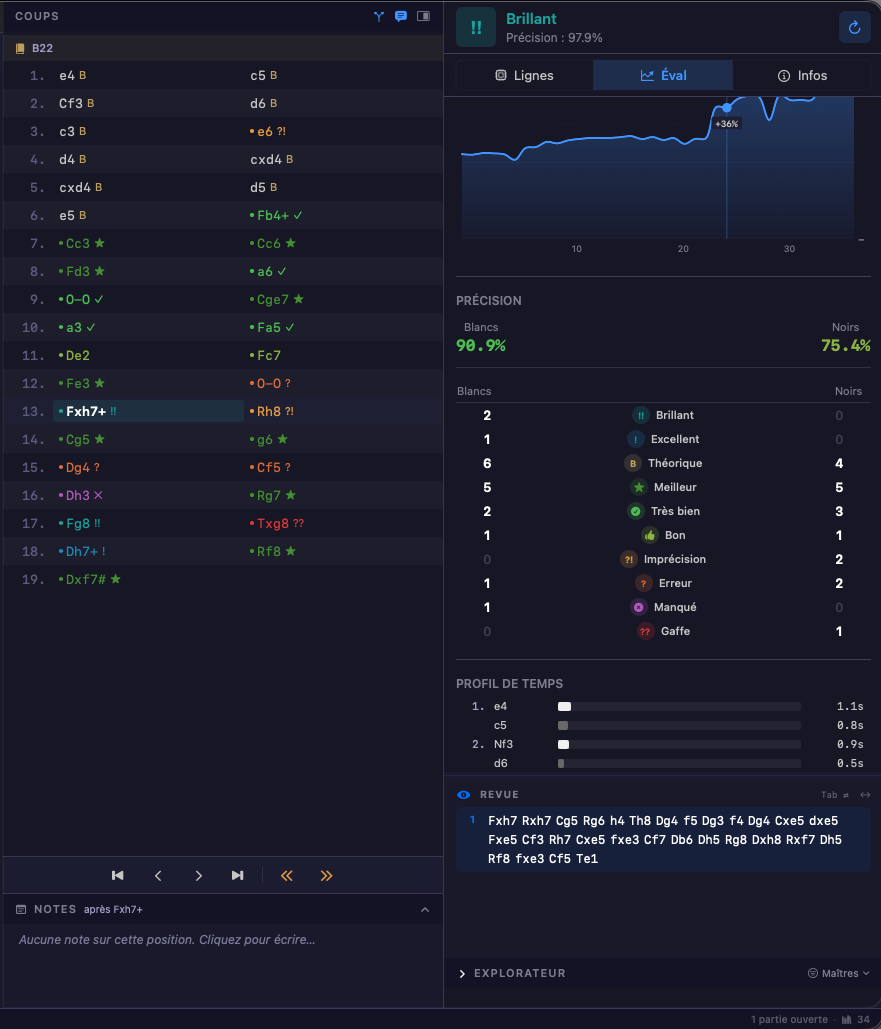 The move list after analysis — every move wears its classification badge.
The eleven categories
| Badge | Category | What it means |
|---|---|---|
| Brilliant | A flawless move that genuinely sacrifices material, and the position holds. Rare — savor it. | |
| Excellent | A flawless move that tips the game your way, far ahead of the second option. | |
| Best | You lost nothing: nobody does better. | |
| Great | Almost flawless — an imperceptible loss. | |
| Good | A correct move, the position holds. | |
| Book | A known theory move — the game is still “in the book”. | |
| Forced | Only one legal move existed. Neither credit nor fault: the position left you no choice. | |
| Inaccuracy | A small slip — a few winning percentage points lost. | |
| Mistake | A real problem: the advantage changes hands or melts significantly. | |
| Miss | Your opponent had just blundered badly and you didn’t punish it. | |
| Blunder | The move that loses. This is the one to understand first. |
The overall logic: categories measure what the move costs in winning percentage, not its beauty. An “ugly” move that loses nothing is Best; there is no bonus for elegance.
Only two categories demand more than a good score, and that is what makes them rare. Both start from a move that loses nothing at all.
Excellent rewards the move that changes the course of the game:
- The game tips. You were equal or worse two half-moves earlier; after this move, you are ahead.
- You were clearly ahead of the engine’s second option. If there were several equally good ways to play, the find wasn’t one.
- It is not a recapture. Taking a piece back isn’t found, it’s imposed.
Brilliant adds the sacrifice:
- Material genuinely offered — and counted net: whatever your opponent had already left hanging before your move is not a gift from you. A combination that cashes in loose material isn’t a gamble, it’s a collection.
- Pins are taken into account: a pinned piece cannot recapture, so the sacrifice is not overstated.
- The position holds after the move — a sacrifice from a lost position redeems nothing.
- Never in an already-won endgame. Converting a settled advantage through trades is technique, not a feat.
The current-move card
At the top of the right panel, a card summarizes the displayed move: its classification spelled out, the game’s accuracy, and for faulty moves the exact loss (for example loss −12.4%) — the price of the move in winning percentage.
Accuracy
Accuracy, shown for White and Black, condenses the game into one number: 100% would be the engine’s game. A few orders of magnitude to place yourself: above 90%, a very clean game; between 75 and 85%, a typical club game; below that, the game was strewn with missed opportunities — good news, the graph will show where.