Training
Knowing your theory and playing it under pressure are two different skills. Régence’s training works on the second: the app puts you in front of your repertoire’s positions, and you play.
A session
Train this opening, in a study’s context menu (or the Train button of its detail panel), opens the session. The rule is simple: the app plays the other side, and at every position where it’s your turn, you play the expected move.
The color isn’t asked for — it’s already recorded in the study. The start screen announces it, and a discreet Change stays there to work the other side of the same study.
- A correct move carries on — the opponent replies, the line advances.
- A wrong move is flagged, with the expected move shown — and the line will be offered again at the end of the session, until you hold it without a miss.
- A hint button progressively reveals the answer when memory stalls.
The session counter tracks progress: current line out of the total, and correct moves out of moves seen.
The end of a line waits for you
A finished line doesn’t run on to the next one by itself. The announcement
stays on screen, below the board, and gives you time to look at the final
position. Continue (or the Return key) moves on to the next line.
Review the line replays it move by move from its start: ‹ and › to
step, Esc to leave. Nothing is changed and the session doesn’t move — this
is the moment to fix the line in memory before going on.
And you can play during the review. Push a three-move idea on the board —
both sides, as in a game — and the engine follows the position you are testing.
Take back undoes the last move, Clear returns to the review position,
and ‹ takes back the try before it moves the step. These moves only exist on
screen: your study is never touched, and the session stays frozen.
Show moves played lists the moves of the current line. Hover one and the mini board of its position opens, with no need to replay the line in your head.
The engine, at the end of the line
This is where — and only where — the analysis appears. The right-hand panel shows the evaluation of the position you reached and the engine’s three best lines. During the drill itself it stays silent: showing its lines mid-line would give the answer away.
Each engine line can be clicked. It then plays out move by move on the
board — with your usual shortcuts: ⇧← and ⇧→ to step through the line,
Tab for the next one, Esc to come back to the position. They are the ones
from Preview, and any custom
keybindings apply here too. Nothing is written into the study: you look, you
understand, you close it.
The panel also tells you what the line you just drilled is worth, even if the study has never been analysed.
To go further — play your own moves, annotate, save a variation — leave training: the analysis board opens on the position of the line you were working on, not at the start of the study.
What you work on: theory, or punishment
A study doesn’t only hold a repertoire. It also holds what the opponent can get wrong, and how to punish it. These are two different exercises, and mixing them dilutes both: you recite ten lines of theory and, halfway through, the opponent hangs a piece.
So the start screen offers What do you want to work on?
| Scope | What it keeps |
|---|---|
| Theory | What you need to know by heart. Lines that only exist because of an opponent’s mistake are set aside. |
| Punishments | Only the lines where the opponent goes wrong: you train to refute. |
| Everything | Both. |
This sorting rests entirely on branch analysis: it’s what knows which side each mistake comes from. Until the study is analyzed, the selector stays inactive — and the screen offers to run the analysis on the spot.
Two settings come with it:
- Shuffle the order of the lines. Without it, lines always come back in the same order, and you end up recognizing the continuation by its place in the queue rather than by the position on the board.
- Include the lines the study condemns. Set aside by default — see below.
The lines the study condemns
A serious study contains counter-examples: “here, definitely not Ng5”. Those lines aren’t instructions, and the drill no longer asks for them. A message tells you how many were set aside at the start of the session.
Again it’s branch analysis that makes the difference: a “bad” variation played by the opponent is legitimate — the study shows how to punish it. The same one played by your side is a counter-example.
When the move played is in the study without being the right one
A crossroads often offers several playable continuations. Answering “wrong” to a move the author wrote as an option himself would teach nothing — worse, it would discourage knowing your alternatives.
So Régence names it, and judges it:
- “Bc4 is as good as Bb5 — the study plays Bb5”: the continuation is just as good. It’s accepted, the session carries on.
- “c3 is playable, but the study prefers Bb5”: the repertoire move is asked for again.
- “Ng5 is in the study, but concedes clearly”: same, and the reason is given.
A move that isn’t in the study, meanwhile, stays a plain mistake.
A position isn’t asked for twice
A repertoire is a tree: its lines share their first moves. Over a thirty-line session, the first move was asked thirty times, the second twenty — and the rare positions, the ones that really deserve the work, came last, once attention had gone.
A position already answered correctly is therefore no longer asked again during the session: it replays by itself, quickly, under the note Already known — moving on.
A position corrected after a mistake does stay to be reviewed: that’s the whole point of the second chance.
Where the current line leads
When the study is analyzed, the panel shows what the line being reviewed is worth — from the point of view of the side being trained, whether you play White or Black. A note flags the lines that teach a punishment.
Reciting a continuation without knowing what it’s worth is learning by heart without understanding. And that’s what fades fastest.
Training a whole folder
Train this folder, in a study folder’s context menu, trains an entire repertoire in a single session — subfolders included. Each study is quizzed from its own side (a White study plays from White’s side, a Black study from Black’s), and a card always shows which study the current line comes from. Statistics, meanwhile, stay counted per study: the session is global, the diagnosis stays precise.
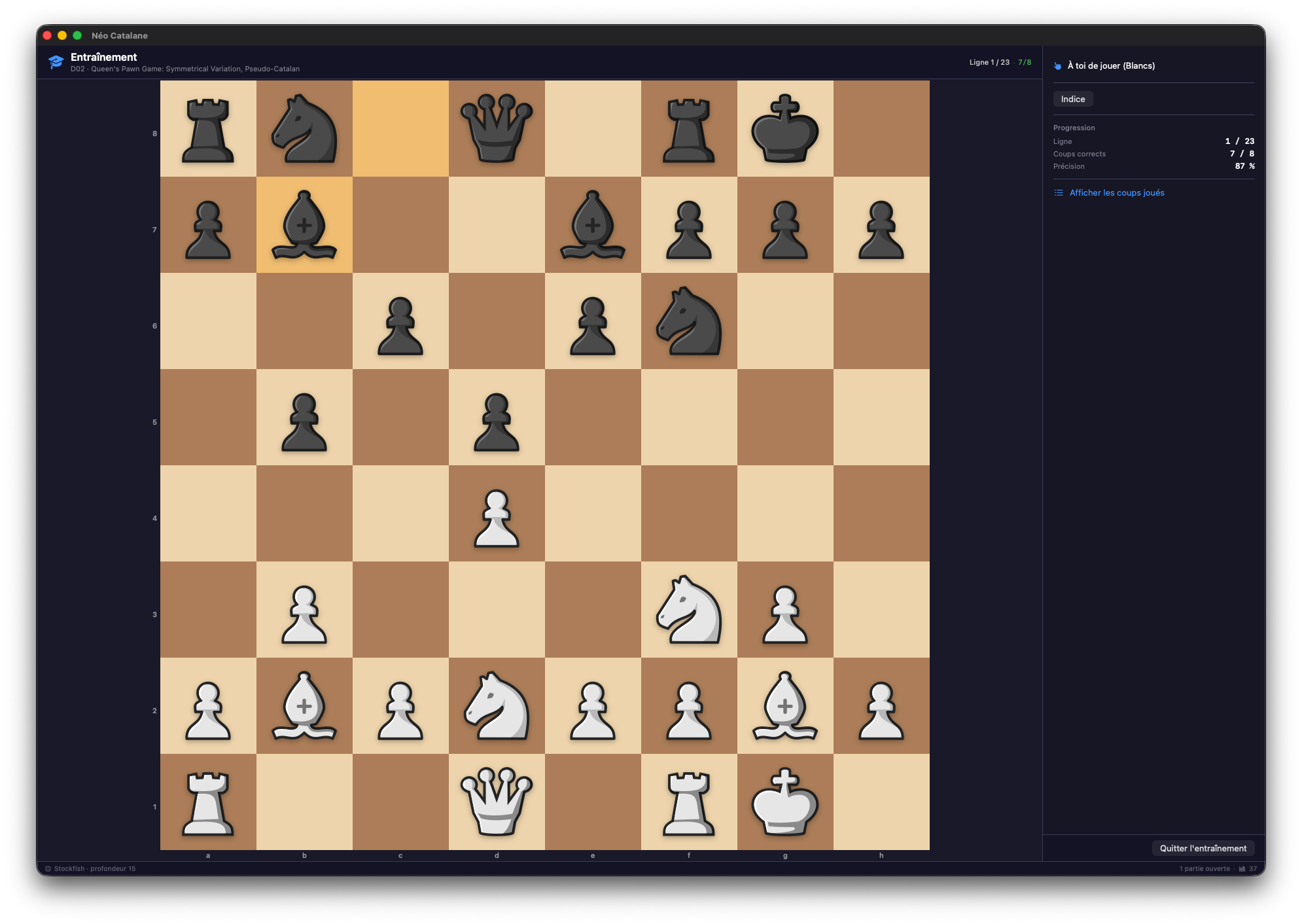 Your move — the repertoire gets recited on the board, not in your head.
Spaced repetition
Behind the session, every position of your repertoire lives in a memory box, from 1 to 5 — the flashcard principle (Leitner system):
- Correct move: the position moves up one box — it will come back less often.
- Wrong move: the position drops back to box 1 — it returns to the front.
Fragile positions thus naturally reappear more often than mastered ones. Nothing to manage: playing your sessions is enough, the system does the sorting.
Reading your mastery
See statistics, in the study’s context menu, draws up the balance sheet: overall success, mastery branch by branch — and that’s where training becomes surgical: a session can start directly from a weak branch, to work only on the variation that falters.